
Categories
Down Memory Lane

The Winter the Earth Trembled

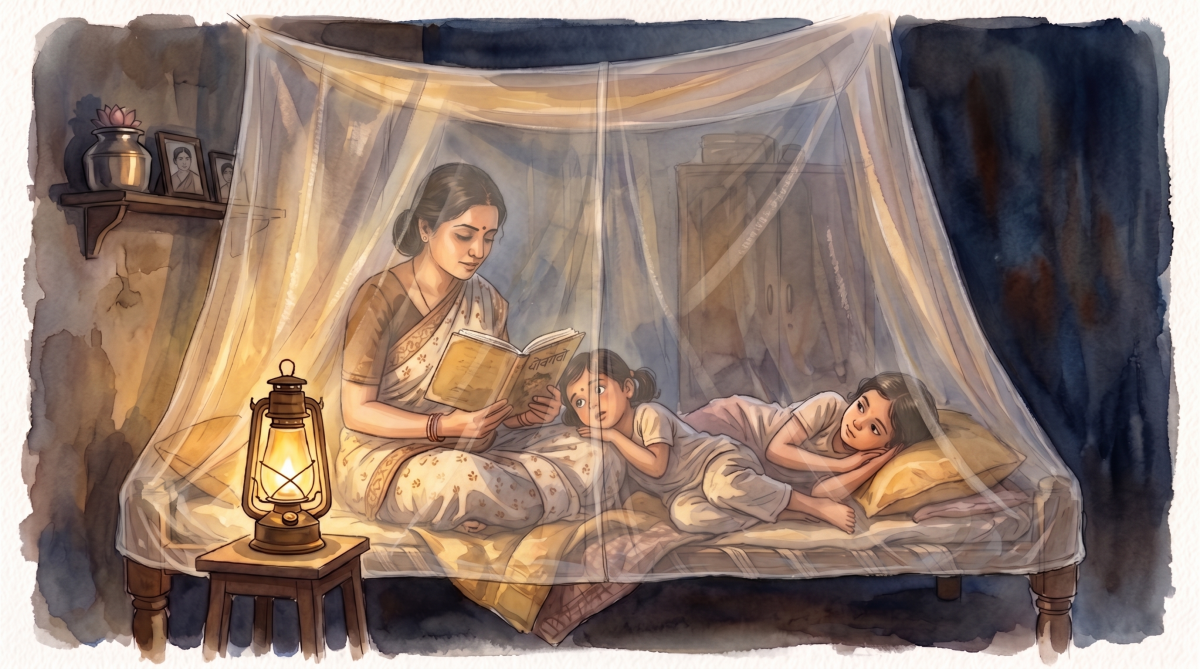
Our member Ms M. Paul was born in Bhagalpur, Bihar. Although the devastating earthquake of 1934 occurred before her birth, its memory lived on through family lore. Over the years, she pieced together the event from vivid accounts shared by elders in her family.

I was born into a joint family in Bhagalpur, Bihar. The house I grew up in was massive, with large terraces, gardens, and courtyards. It was inhabited not only by people but also by pets—animals and birds—and contained libraries full of books, journals, and magazines.
As a child, I was intensely curious and often shadowed my elders. I would hear them speak of a devastating earthquake which struck one winter afternoon, in 1934, tearing through several towns and cities across the country. That afternoon, my eldest sister, then just two years old, was asleep in our bedroom. As my mother entered the room, there was a loud noise. At first, she assumed it was the municipal garbage truck that passed by daily at that hour. Moments later, she realised with horror that the ground was shaking.
Picking up my sister, my mother ran outside to find the house engulfed in a thick cloud of dust. An aunt and uncle lived in an adjoining room and were arguing loudly, completely unaware of nature’s fury. My mother’s frantic knocks went unanswered, so she burst in and shouted that there was an earthquake.
They rushed towards the staircase, which was swaying so violently that nothing could be clearly seen. Somehow, they managed to make their way downstairs. The only exit from the house was through a medicine dispensary, which lay in complete disarray; medicines were strewn across the floor and there were shards of glass everywhere. With no alternative, they walked through it, cutting their feet and bleeding, before finally stepping out onto the road.
My mother stood outside with my aunt, uncle, and their two children. They were covered head to toe in white cement dust. Gradually, the rest of the family emerged from the crumbling house, bruised and bleeding. Ironically, it was impossible to enter the dispensary to retrieve medicines. Though it belonged to our family, nature seemed to have barred its owners from it that day. The house continued to disintegrate as cement cornices and awnings crashed down noisily. The family stood helplessly, watching their home succumb to nature’s wrath. Eventually, the tremors subsided. The house was uninhabitable, and everyone wondered whether they would be forced to live on the streets through winter. Slowly, they re-entered and assessed the damage. With effort and repair, it seemed possible to return, though extensive work was needed. Remarkably, the thakurghor (prayer room) remained untouched. Gopal and his consort Radha sat serenely on their throne, adorned in their finery.
A field in front of the house belonged to the family, and it was decided to build temporary huts there. Mud houses soon appeared, with straw roofs and a brick boundary wall. Over time, a kitchen garden took shape, and flower patches added colour to their lives.
Those days were filled with fear for my mother. The jungle was close by, and at night she carefully checked the bedding for snakes and scorpions.
My father was in Kolkata on business when the earthquake struck. Railway tracks were badly damaged, and it took several days for him to return. When he finally arrived, he found the family living in temporary shelters. He walked in to see Pishima, one of my aunts, boiling milk for the entire household. The milkman would deliver galloons which would be poured into a large cauldron. It would be diluted with an equal amount of water, and boiled thoroughly to kill bacteria before being reduced to its original quantity—a task requiring full attention.
As my father entered, he saw the family gathered around Pishima, waiting for their share of milk. Only his wife and two-year-old daughter were missing. He asked if everyone was safe. Distracted, Pishima merely grunted. He asked again, stressing on the word “everyone,” and again received only a grunt. Alarmed, he feared the worst, until he finally spotted us and breathed a sigh of relief.
Aftershocks continued for days. The family lived in the huts for two-and-a-half years while repairs were underway. My grandmother survived the earthquake, and the thakurghor remained functional. My sister would go there to play with Gopal, flinging Radha aside and cradling him in her arms. Amused, my grandmother began calling her Meerabai.
Sadly, my grandmother, Hemangini Dasi, did not live to see the family home fully restored. She passed away in one of the huts, leaving behind six married sons and many grandchildren. In time, the family returned to their rightful home, carrying with them the memory of that devastating day, slowly learning to leave its trauma behind.

(as narrated to Support Elders by our member)
Categories
Down Memory Lane

My Mishibaba – Part 2

Some bonds form quietly, without ceremony, yet they leave the deepest mark on our lives. In this moving short story, our member Mr A. K. Ray remembers Mishibaba—a little black puppy who grew into the heart and guardian of his neighbourhood.

It was a Thursday. I had some important work across the river and had to go by ferry. I dressed and stepped out when Mishibaba appeared, following me. No matter how I tried to explain, he refused to understand. Even when I pushed him away, he kept returning and rubbing his face against my knee. Finally, I gave in: “Fine, come along then.” Little did I know this decision would bring disaster. We rode to the ferry ghat in a rickshaw. His joy knew no bounds; it was his first time riding any vehicle, and that too with me.
I bought my ticket and one for him too. The ferry, locally called a bhotbhoti, was waiting to start. A young man with headphones got up and offered me his seat. I thanked him. Mishibaba stood by my feet, front paws on my lap, staring in amazement at the unfamiliar world around him.
Beside me sat a young rural woman with her seven-year-old daughter. The child was extremely restless. She went from standing to sitting to leaning over the railing, earning a constant scolding. But she wouldn’t stop.
The river was at ebb tide. During such a tide, the ferry couldn’t cross directly and had to go slowly in a long arc. Piles of water hyacinth drifted past in the current.
We had barely moved a few metres from the jetty when, holding the railing and leaning too far out, the little girl suddenly slipped and fell into the water. It caught everyone by surprise. The mother began wailing, her cries tearing through the air.
Chaos ensued. Everyone had some idea or another, but no one took any action. Without hesitation, Mishibaba leapt into the river. Panic gripped everyone. Time seemed to hold its breath.
A fisherman’s dinghy lay anchored near the bank. Hearing the commotion, the fisherman began rowing frantically towards the spot. It had only been a few minutes.
Suddenly, a glimmer of hope appeared a little distance away. Mishibaba was struggling, lifting his head with all his strength. He had clamped his jaws onto the girl’s dress, trying desperately to push forward. But he could no longer fight the current. He was slipping back, bit by bit. It felt as if he was saying, “I can’t go any further… now it’s your turn.”
The fisherman’s boat reached them just in time. Leaning down, he stretched out his arms and lifted the little girl out of the water. He brought her safely back to shore.
But no one reached out to my Mishibaba. No one pulled him out. He drowned, carried away by the force of the river, vanishing forever.
The little girl survived.
Even today, when I think of Mishibaba, a quiet ache settles in my heart. His courage cost him his life, yet his final act was one of pure, instinctive goodness—an unspoken offering to the world. Mishibaba may no longer walk beside me, but the memory of his loyalty and bravery remains a comforting light, reminding me that even though he is gone, his memory will continue to warm me.

(The story has been translated from Bengali by our editor)