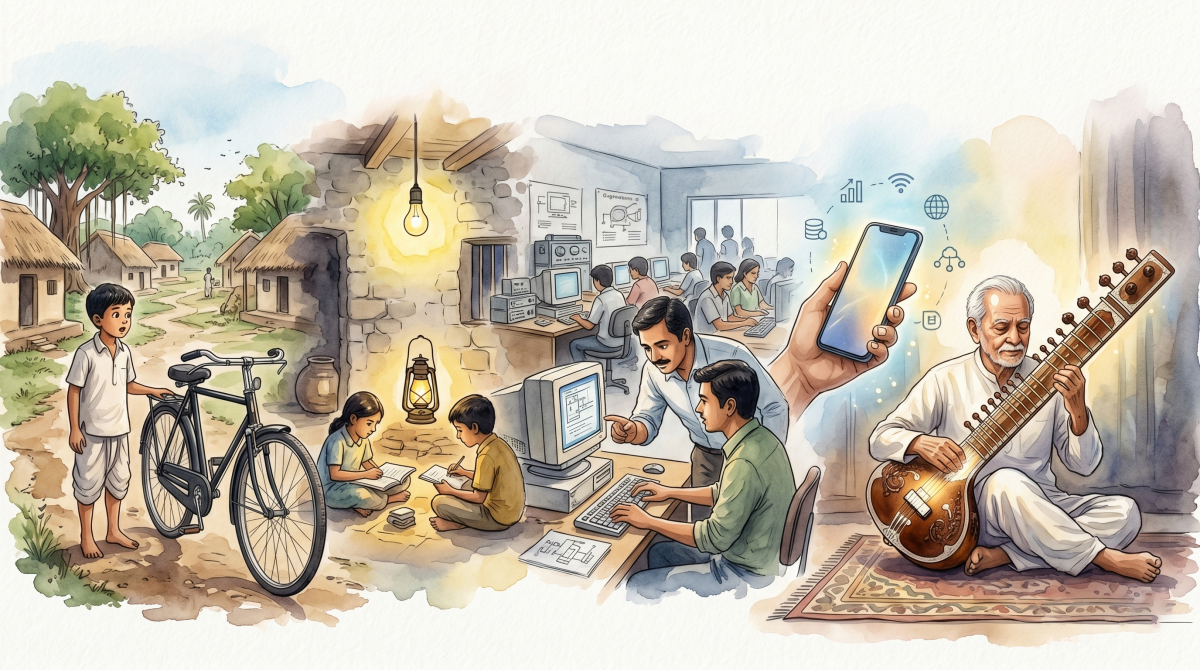


From a childhood shaped by simplicity to a lifetime of witnessing rapid innovation, our member Mr D. Goswami reflects on the remarkable journey of technology over the decades.
I spent my childhood in a calm and beautiful village, where life moved at an unhurried pace. For us children, the bicycle was a real marvel. Even that was rare, since there were only three or four in the entire village. My father owned one with a three-speed gear system, which seemed like an extraordinary technological advancement at the time. The ability to shift speeds felt almost magical to us.
Beyond that, there were motor cars, trains, and telegraph lines, but they felt distant from our daily lives.
I first experienced electricity at the age of 14, when I moved to my uncle’s house in 1954 for my education. It was a small town where electricity was generated by a private entrepreneur. The supply was unreliable and available only for a few hours after dusk. There was also a curious belief among some of my classmates. Only a few homes had electricity, and it was said that using electric light weakened eyesight. Many preferred studying under a table lamp or lantern, convinced it was safer for their eyes.
Over time, electricity became more stable, especially after the Electricity Board took over its generation and distribution. Today, it is impossible to imagine life without it. Electricity has become the very lifeline of modern existence.
Years later, when I joined as the Head of the Department of Electronics at Assam Engineering Institute in Guwahati in 1995, I witnessed another significant shift. Under a Government of India initiative, our laboratories, including the computer lab, were upgraded with modern equipment. Until then, my exposure to computers had been limited. I found myself becoming a student once again, learning from my colleagues and through various training programmes. Gradually, we became adept at using computers, a skill that soon proved indispensable.
The transformation of mobile phones has been equally remarkable. I first used one in 2002, and it baffled me how such a simple, compact device could be used for distant communication. Over the years, it has evolved into something far more powerful. Today, a mobile phone is almost an extension of ourselves. It serves as a tool for communication, banking, shopping, entertainment, and much more. Looking back, it is evident that our lives are now deeply dependent on technology. Without it, even the simplest routines would come to a halt.
Yet, amidst all these advancements, my most cherished companion is not a modern gadget but a traditional instrument—the sitar. I spend much of my time with it. Though I am not an expert player, it brings me immense joy. In a world driven by technology, it offers me a sense of peace and continuity.
(as narrated to Support Elders by our member)
Categories
From Bicycles to Bytes: the Changing Face of Technology