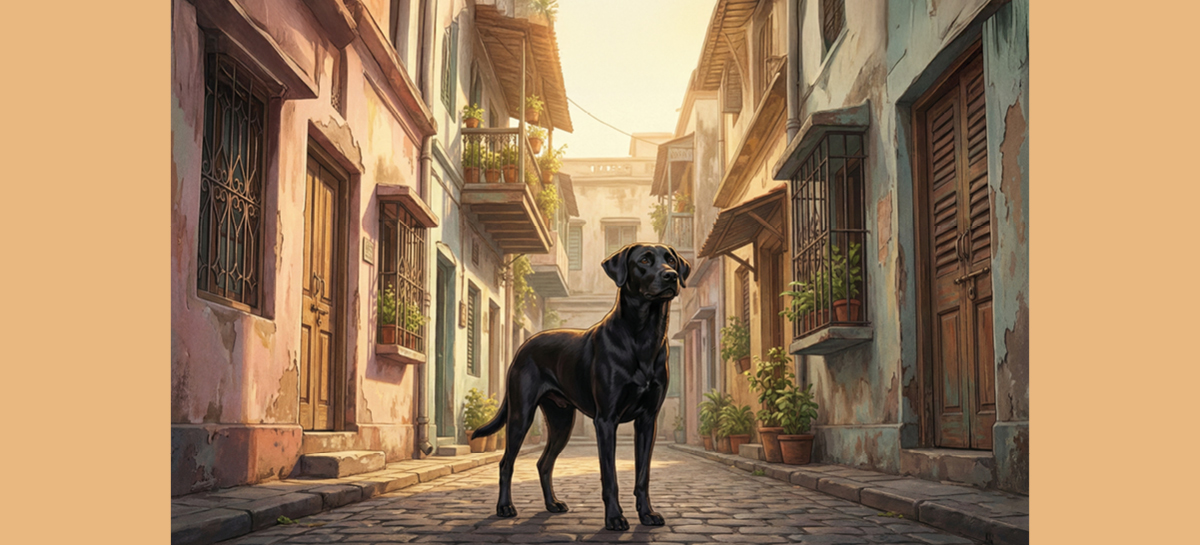


Animals often understand love and loyalty in ways we humans struggle to define. In this moving short story, our member Mr A. K. Roy remembers Mishibaba, a street dog whose gentle affection and extraordinary courage left an indelible mark on his life.
Kalu was the king of our locality. Some called him Kalu Sardar, others called him Kalu Mastan. He had two loyal companions who handled the minor skirmishes of street life. Kalu never bothered with the petty cases. No matter how big the trouble, his boys would risk their lives for him without hesitation. And Kalu himself was not the type to sit back and relax after sending his troops ahead. He always stood ready.
There are some beings who instinctively leap forward for others, even at the risk of their own lives. Kalu belonged to that rare kind. When I first befriended him, he was a tiny, jet-black, soft, plump, month-old puppy. By black I mean pitch black, without the slightest hint of any other shade. He had a brother too, also black, but with splotches of white on his coat.
The two pups had just begun to explore the world. They played with their mother, wrestling and tumbling about. Sometimes she would leave them to scavenge for food. And then, one afternoon, tragedy struck: Kalu’s brother was crushed under the wheels of a delivery van. When the mother returned, she cried inconsolably. The grief of a mother, whether human or animal, sounds the same. She sat beside her dead pup, then looked helplessly at passers-by, her tear-filled eyes asking, “What harm did my child do to you that he had to die like this?”
But Kalu’s misfortune did not end there. Just three or four days later, municipal workers came and, along with a few other stray dogs, whisked away Kalu’s mother in a van. When human cruelty shows its true face, humans seem far lower than animals. In this merciless world, Kalu was left alone and utterly helpless.
He cried the entire night—deep, wrenching sobs. Dew began to fall. Curled up on the dry leaves beneath the tagar tree in my garden, he wept until dawn. I couldn’t sleep either; I kept waking with a start. I waited anxiously for morning. As soon as light broke, I gently lifted that soft, trembling bundle of sorrow and brought him inside.
With the love of the entire neighbourhood, Kalu grew up quickly. His coat glistened brightly. I lovingly named him Mishibaba. He adored that name. No matter where he roamed, the moment he heard “Mishibaba!”, he would race back like lightning, panting, lifting his face as if to say, “Your faithful one is here—what do you command?” A single pat on his head or neck, and he would melt with happiness.
Mishibaba ruled our entire lane. Night after night, he patrolled tirelessly from one end to the other. Together, he and his little troop kept our nights almost completely safe. Everyone in the neighbourhood loved him and fed him in their own ways. But if anyone threw food at him casually, he would never touch it—he was too proud for that.
After patrolling the whole night, he liked to sleep a little in the early morning. On winter mornings, if a patch of soft sunlight fell on him, he would forget food and water and lie down right by the side of the road. In summer, he would come and sleep in his swing-bed. An old wooden swing had been lying around for years. I had kept it in the inner verandah, and I had neatly set up a bedding on it for him. Whenever he was very tired, or on rainy days or nights, he would curl up there and sleep.
After his short morning nap, he would get up exactly at breakfast time. His sense of time was remarkable. He had no special demands. Whatever I could give, he accepted with a shining, grateful face. If he got an egg with his roti, he would be overjoyed. In the afternoon he ate simple dal and rice. If there were two pieces of meat—especially with a bit of bone—he would lick his bowl clean.
During the day, he would sometimes vanish. In truth, he went to the neighbouring lanes to assert his authority. Everyone knew well about his strength and courage. A weaker dog that happened to cross his path would either sit a few steps ahead or roll over on his back, as if to say, “Master, I am your humble servant. Do as you please.” Mishibaba thoroughly enjoyed this display of submission. This desire—to feel superior—exists in all living beings. But when the other dog surrendered, Mishibaba never hurt them; he would look at them with compassion.
Mishibaba was not just a stray dog; he was a guardian, a friend, and a silent witness to our lives. For us, he was family. And in his loyalty and courage, he taught us what true nobility looks like—not in words, but in the quiet dignity with which he lived.
Once or twice a month I would pull him along for a bath. He resisted fiercely. We had a mini battle each time. After bathing, he would shake himself on purpose and get me drenched. But he loved being brushed with brass; he would sit and enjoy it thoroughly. After brushing, he would look up at me as if asking, “Won’t you kiss me?” And when I kissed him, he would close his eyes in
bliss.
Once I thought of putting a collar and belt on him. I wasn’t sure how he’d take it. But once it was on, he walked with such pride—as if he had been awarded the badge of Commander-in-Chief.
Life went on peacefully. Humans may rule the present, but the future lies beyond our control.
To be continued…
(The story has been translated from Bengali by our editor)
Categories
My Mishibaba – Part 1